


Franchise Baseball: Pro GM
Fantasy Moguls, Inc.
I usually approach franchise management games with two questions: can I make meaningful decisions without studying a manual, and does the daily routine stay interesting after the first few sessions? Franchise Baseball: Pro GM makes a good first impression because it focuses on the part many baseball fans enjoy most: building and guiding an organization rather than controlling every pitch by hand. Fantasy Moguls, Inc. presents it as a fast, accessible sports game, and that description fits my experience better than calling it a full simulation.
This is a free baseball management game for Android, aimed at Everyone, with a 4.4 average from around 3.2 thousand ratings and more than 500 thousand installs. It has been available since July 3, 2018, and the current version is 4.11.13. Those details matter less than the way the game feels in practice, but they do tell me that it has had time to develop a recognizable audience rather than being a brand-new experiment.
How the everyday franchise routine works
The basic workflow is easy to understand. I step into the role of a general manager, make choices for a baseball franchise, and watch those decisions shape the team over time. Instead of asking me to react to every ball and strike, the game puts attention on the broader rhythm of a season: deciding what deserves attention now, what can wait, and how much responsibility I want to take for each part of the organization.
That makes it particularly comfortable for short sessions. I can open it while waiting for an appointment, review the current state of the club, make a few decisions, and leave without feeling that I abandoned a live match at a critical moment. The “fast” part of the store summary is believable in this sense: it is designed around management choices rather than a long, manual play-by-play commitment.
My advice for a first session is not to change everything immediately. I get better results by identifying the current problem first. If the team is underperforming, I ask whether the issue is the lineup, pitching, depth, or simply an unrealistic expectation for the roster. Changing several areas at once makes it difficult to understand which decision helped. A slower opening hour pays off because it gives the franchise a clear baseline.
Related News

Threads in Real Life: Who Should Join, Lurk, or Leave

How SHEIN Turned Shopping Into an Endless Content Feed

How to Make Fortnite Feel Smarter on Mobile

Should You Switch to Microsoft Outlook on Mobile?

Why Gallery Keeps Pulling Users Back

X Review: Why Its Network Still Matters
The game is also more approachable than a traditional spreadsheet-heavy baseball simulator. I do not need to know every advanced baseball statistic before I can enjoy it. A fan who understands the basic roles of hitters, pitchers, prospects, and roster depth can begin making sensible choices quickly. At the same time, the structure leaves room for players who enjoy thinking several moves ahead.
A realistic everyday scenario is a short evening check-in. I might have only ten minutes, so I review the roster, look for an obvious weakness, and make one deliberate adjustment instead of trying to rebuild the entire club. That small habit makes the game feel less like homework. It also prevents the common mistake of spending a whole session reacting emotionally to one poor result.
Start with a repeatable baseline
Experienced play begins with consistency. I like to use the same order each time: check the overall team situation, inspect the area causing the most concern, make the smallest useful change, and then give the decision enough time to show its effect. This is not a flashy strategy, but it makes the management layer easier to read.
Gallery
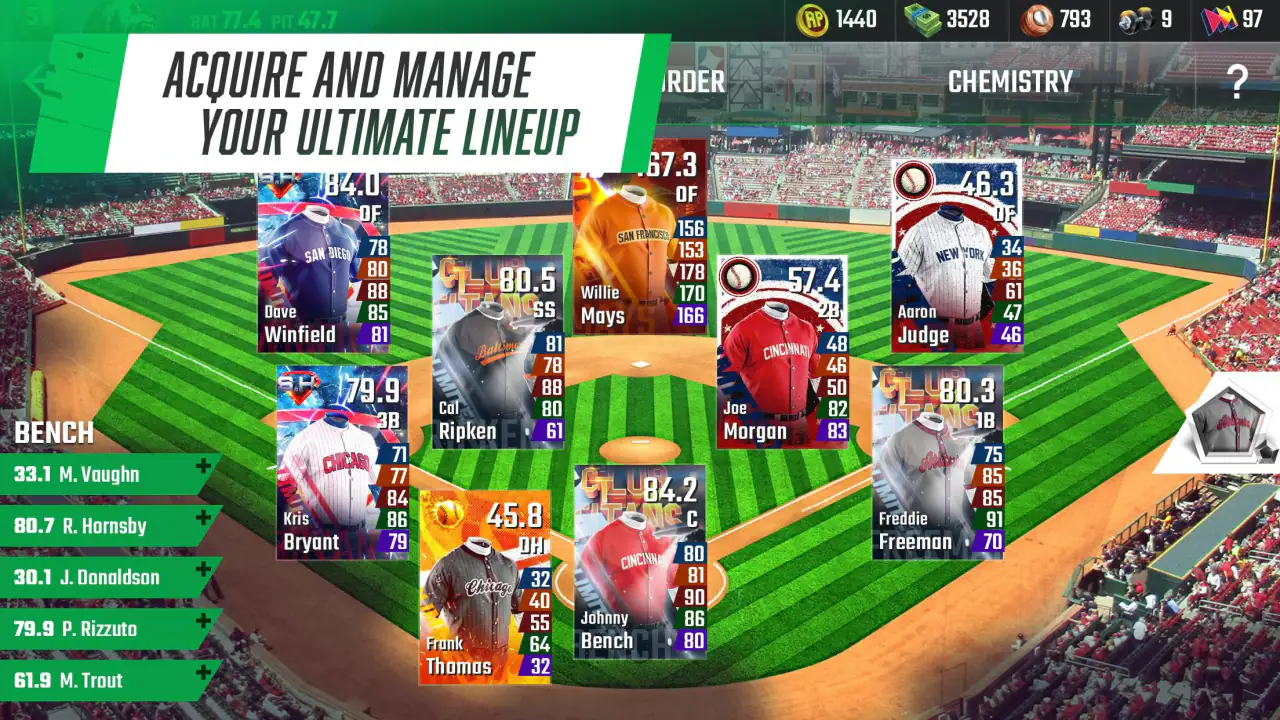
The biggest hidden advantage of this routine is information. If I constantly alter the lineup, pitching choices, and broader team direction together, every result becomes noisy. By changing one meaningful variable at a time, I can tell whether I am solving a genuine weakness or merely chasing the latest outcome. That approach is useful for new players and essential for anyone who wants to improve rather than simply tap through a season.
I also recommend separating urgent decisions from attractive ones. A promising improvement may still be the wrong move if it leaves the team exposed somewhere more important. In a franchise game, the best choice is often the one that keeps the roster balanced, not the one that produces the most exciting individual upgrade.
Settings and controls worth checking early
The most useful settings are the ones that reduce friction without taking away the decisions I actually enjoy. Before settling into a long-term franchise, I check how the game handles notifications, sound, display behavior, and any available automation or confirmation choices. I do not assume that every player wants the same balance between reminders and quiet play, so I adjust the experience to match how often I plan to open the game.
If I am checking in several times a day, unnecessary alerts can make the game feel demanding. If I only play once in a while, reminders may help me remember where I left the franchise. The practical tip is to treat notifications as part of the strategy, not just a phone preference: a useful reminder supports a routine, while too many interruptions make the routine feel like an obligation.
I also pay attention to confirmation steps before committing a meaningful roster or franchise decision. In management games, speed is helpful only when it does not turn into accidental tapping. When I am experimenting, I slow down and read the available choice carefully. Once I understand the flow, I use the quickest path for routine checks and reserve careful review for decisions that will affect the team over time.
Sound is another small but worthwhile adjustment. I often play in public or while doing something else, so I prefer a quiet setup and rely on visual information. Players who want a more game-like atmosphere may enjoy audio, but it is not necessary for understanding the management layer. The important point is that the game remains usable as a low-volume, short-session experience.
There is also a practical device consideration. The minimum operating system is Android 7.0, so owners of older phones should check compatibility before planning around it. On a supported device, I would still keep the normal habits that help any mobile management game: close demanding background apps if performance becomes inconsistent, keep the system updated, and avoid judging the game from one rushed session while the phone is busy with other tasks.
Faster patterns that preserve good decisions
Once I understand the baseline, I speed up by grouping tasks. Instead of opening the game repeatedly to make isolated changes, I review related information in one sitting. For example, I might look at the roster situation first, decide what kind of adjustment is needed, and then stop. This prevents the endless loop of opening the game, making a tiny change, reopening it, and losing sight of the larger plan.
Another useful pattern is to keep a simple mental record of decisions. I remember what I changed and why: improving depth, addressing a weak area, or testing a new direction. I do not need a separate spreadsheet to enjoy the game, but remembering the reason behind each move makes later results more meaningful. It also helps me avoid reversing a decision simply because the next result was disappointing.
I find it helpful to create two modes of play. In routine mode, I move quickly through familiar checks and avoid overthinking ordinary results. In evaluation mode, I slow down when the franchise reaches a meaningful turning point, such as a roster reshuffle or a sustained problem. This distinction keeps the game from becoming either mindless tapping or constant analysis.
Players who spend money should apply the same discipline. The game is free to download and includes in-app purchases ranging from $0.99 to $79.99 per item. I would not treat a purchase as a shortcut to understanding the franchise. Before spending, I would first decide whether the item solves a problem I genuinely have or merely feels tempting because of a recent loss. The free entry point is a strength, but the wide purchase range means a personal spending limit is sensible.
My strongest practical tip is to avoid making a purchase during a frustration cycle. If the team has just produced a poor result, I wait, return to the baseline workflow, and identify the actual weakness. That habit protects the strategic side of the game and keeps optional spending from replacing thoughtful management.
Where the management depth reaches its limits
Franchise Baseball: Pro GM is not the right choice for everyone. If I want direct control over every at-bat, detailed on-field mechanics, or the sensation of physically playing a baseball game, I would choose a conventional baseball title instead. This game is built for people who enjoy decisions around a team, not for players who want a controller-style sports experience.
It can also feel too light for someone seeking an extremely detailed front-office simulator. The accessible structure is part of its appeal, but it also means I should not expect the same level of complexity as a specialist simulation built around exhaustive statistics, contracts, scouting layers, and long-form financial planning. The trade-off is clear: faster onboarding and shorter sessions in exchange for a less demanding management environment.
Another limitation is psychological rather than technical. Because the game encourages quick decisions, I can easily turn it into a sequence of taps if I stop asking why I am making changes. The title rewards a player who supplies some of the discipline. If I want the game to feel strategic, I need to set goals, observe consequences, and resist changing direction after every result.
New players may also wonder whether baseball knowledge is required. My answer is no, but a basic understanding helps. I can learn the broad logic through play, yet the experience becomes more satisfying when I recognize why roster balance, depth, and role choices matter. Someone completely unfamiliar with baseball may enjoy the accessible presentation but could need extra time to develop an instinct for which problems deserve priority.
It is worth considering the age rating as well. The game is rated Everyone, which matches its general audience and makes it suitable for players looking for a non-aggressive sports management experience. That does not mean every child will understand the strategic choices immediately; younger players may still benefit from guidance when deciding how to use optional purchases or how to interpret team results.
Who gets the most from it
I would recommend it to baseball fans who like constructing a plan more than controlling a match. It suits people who enjoy checking a team during spare moments, making a few decisions, and returning later to see whether the organization is moving in the right direction. It is also a good entry point for someone curious about general-manager games but unwilling to begin with a highly technical simulator.
It works especially well for players who enjoy repeatable habits. The satisfaction comes from improving the quality of decisions over time: spotting problems earlier, avoiding unnecessary changes, and learning which parts of the franchise deserve attention. The game becomes more rewarding when I treat each session as part of a longer project rather than as a demand for immediate success.
I would steer away from it if my priority were realistic on-field action, deep statistical research, or a completely hands-off experience. Players who dislike waiting for management choices to develop may also lose interest. The title asks for patience in small doses; quick sessions are possible, but meaningful progress still depends on observing consequences rather than expecting every tap to produce an instant payoff.
My final assessment after settling into the routine
What I like most is the balance between accessibility and responsibility. The game does not bury me under baseball terminology before I can begin, yet it gives my choices enough context to make a franchise feel like something I am guiding. Its strongest use case is a short, repeatable management session where I review the situation, make one or two purposeful decisions, and leave with a clear idea of what I want to watch next.
What I like least is that the lighter structure can expose shallow habits. If I rush through every screen or react to each result, the experience loses much of its strategic value. I have to bring the patience myself. That is not a deal-breaker, but it is an important distinction between enjoying the game and merely operating it.
For a free sports game from Fantasy Moguls, Inc., it offers a friendly way into baseball franchise management without demanding a full evening. The current version is 4.11.13, and the established audience suggests that the concept has found players who appreciate this compact format. I would start with the free experience, adjust the settings to fit my routine, and set a personal purchase boundary before exploring optional spending.
My verdict is positive, with a clear condition: choose it for the decisions behind the baseball, not the action on the field. If that is the part of the sport I want to explore, this is an enjoyable and approachable companion for spare moments. If I need a deep simulation or hands-on gameplay, another kind of baseball app will serve me better.
FAQs for Franchise Baseball: Pro GM
What is Franchise Baseball: Pro GM?
Franchise Baseball: Pro GM is a baseball management simulation focused on building and running your own professional team. Instead of controlling every pitch directly, you take the role of general manager, handling roster construction, trades, scouting, player development, contracts, lineups, and long-term strategy. It is designed for players who enjoy planning a franchise and making decisions that shape a team over multiple seasons.
Can I play Franchise Baseball: Pro GM offline?
The game may allow some franchise-management activities without a constant connection, but online requirements can vary depending on the platform version and the feature you are using. Cloud saves, account services, updates, advertisements, leaderboards, or other connected functions may require internet access. Before downloading, check the current store listing and test the game with your connection disabled if offline play is important to you.
Is Franchise Baseball: Pro GM suitable for beginners?
Franchise Baseball: Pro GM can be enjoyed by newcomers, but it is primarily aimed at players who like detailed sports-management systems. Beginners may need time to understand player ratings, finances, contracts, scouting information, and the effects of different roster decisions. The best approach is to start conservatively, review the available explanations, and avoid making major trades or expensive signings until you understand your team’s needs.
Does Franchise Baseball: Pro GM include real teams and players?
Whether the game uses officially licensed teams, leagues, and player names depends on its current edition and licensing arrangements. Management games sometimes use fictional rosters or names that resemble real baseball without offering official licenses. If authentic teams and players are important to you, carefully read the developer’s description and screenshots on the Android or iOS store page, since roster content can also change through updates.
Are there in-app purchases or advertisements in Franchise Baseball: Pro GM?
The availability of advertisements, premium features, or in-app purchases can differ between Android and iOS versions and may change after updates. Some management games offer optional purchases for convenience, extra content, or faster progression, while others use a one-time payment or advertising-supported model. Review the store’s “in-app purchases” and “contains ads” labels before downloading, especially if you prefer a completely uninterrupted experience.
Pros
- Deep roster management suits fans who enjoy long-term planning.
- Player development adds meaningful progression beyond individual games.
- Trade negotiations and scouting make team-building feel strategic.
- Season simulations let you manage a franchise without lengthy matches.
- Clean menus make most front-office tasks easy to access.
Cons
- Progress can feel slow when upgrading facilities or developing players.
- The interface may seem dense for newcomers to baseball management games.
- Limited on-field control may disappoint players seeking hands-on gameplay.
- Advanced features can be difficult to understand without careful experimentation.
- Frequent management decisions may become repetitive during longer seasons.


